


The theme for this year’s Mental Health Awareness Weeks is Anxiety.
What is Anxiety?
Anxiety is a feeling of unease, such as worry or fear, that can be mild or severe.
Everyone has feelings of anxiety at some point in their life. For example, having a new job interview or having an exam. This is a normal experience that everyone has felt at certain times in their life. However, some people find it hard to control their worries. Their feelings of anxiety are more constant and can often affect their daily life. Anxiety is the main symptom of several conditions, including panic disorder, phobias, post-traumatic stress disorder and social anxiety disorder (social phobia).
Generalized Anxiety Disorder (GAD)
GAD is a long-term condition that causes you to feel anxious about a wide range of situations and issues, rather than one specific event.
People with GAD feel anxious most days and often struggle to remember the last time they felt relaxed. GAD can cause both psychological (mental) and physical symptoms. These vary from person to person, but can include feeling restless, having trouble concentrating or sleeping and panic attacks and anxiety attacks.
What causes GAD?
The exact cause of GAD is not fully understood, although it’s likely that a combination of several factors. Some include:
- overactivity in areas of the brain involved in emotions and behaviour
- an imbalance of the brain chemicals serotonin and noradrenaline, which are involved in the control and regulation of mood
- the genes you inherit from your parents – you’re estimated to be five times more likely to develop GAD if you have a close relative with the condition
- having a history of stressful or traumatic experiences, such as domestic violence, child abuse or bullying
- having a painful long-term health condition
- having a history of drug or alcohol misuse
However, many people develop GAD for no apparent reason.
Symptoms of GAD?
- Feeling restless, wound-up, or on-edge
- Being easily fatigued
- Having difficulty concentrating
- Being irritable
- Having headaches, muscle aches, stomachaches, or unexplained pains
- Difficulty controlling feelings of worry
- Having sleep problems, such as difficulty falling or staying asleep
If you think you may have an anxiety disorder, it is important that you speak to someone close to you that you trust that can help you.
When to see a doctor:
- You feel you are worrying too much and it is interfering in your daily life and routine
- Your anxiety is worrying you and difficult to control
- You are feeling depressed
- You avoid certain situations because it triggers your anxiety
When having an anxiety disorder, some people may experience panic attacks or anxiety attacks.
Panic attacks:
Panic attacks are a type of fear response.
What do panic attacks feel like?
During a panic attack, physical symptoms can build up very quickly. These can include:
- a pounding or racing heartbeat
- feeling faint, dizzy or light-headed
- feeling very hot or very cold
- sweating, trembling or shaking
- nausea (feeling sick)
- pain in your chest or abdomen
- struggling to breathe or feeling like you’re choking
- feeling like your legs are shaky or are turning to jelly
- feeling disconnected from your mind, body or surroundings, which are types of dissociation
During a panic attack you may feel like you are going to faint or you are losing control.
Anxiety attacks:
Symptoms of anxiety attacks include:
- Surge of overwhelming panic.
- Feeling of losing control or going crazy.
- Heart palpitations or chest pain.
- Feeling like you’re going to pass out.
- Trouble breathing or choking sensation.
- Hyperventilation.
- Hot flashes or chills.
- Trembling or shaking.
- Nausea or stomach cramps.
- Feeling detached or unreal.
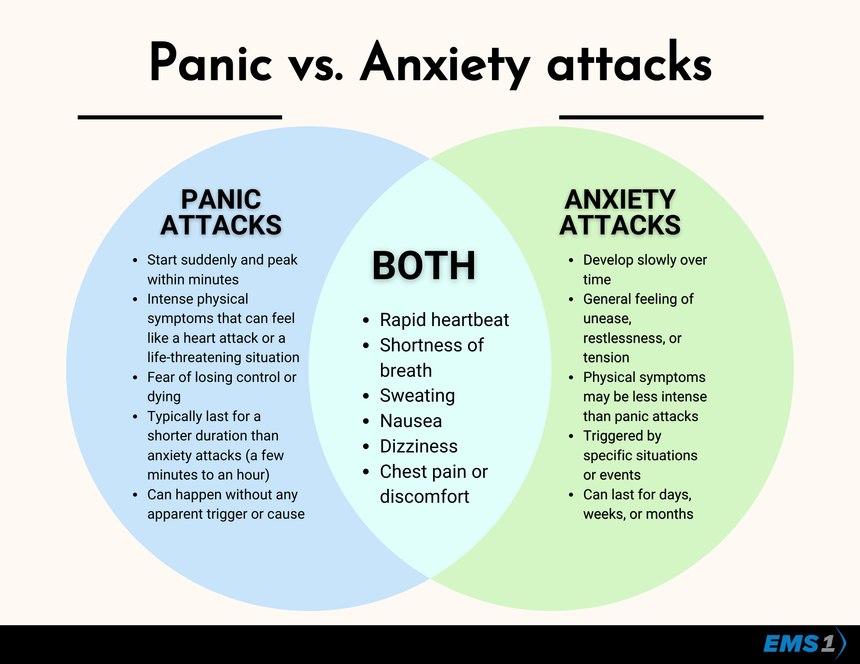
What is the difference between an anxiety attack and a panic attack?
Panic and anxiety attacks both cause a rapid heart rate, shallow breathing, and a sense of distress.
However, they typically differ in severity and cause.
Panic attacks are often more intense and can occur with or without a trigger, while anxiety attacks are a response to a perceived worry.
What to do in an anxiety attack or panic attack?
If you’re breathing quickly during a panic attack, doing a breathing exercise can ease your other symptoms. Try this:
- breathe in as slowly, deeply and gently as you can, through your nose
- breathe out slowly, deeply and gently through your mouth
- some people find it helpful to count steadily from 1 to 5 on each in-breath and each out-breath
- close your eyes and focus on your breathing
- use the 333 rule- It is looking around your environment to identify three objects and three sounds, then moving three body parts. Many people find this strategy helps focus them when anxiety overwhelms them.
The Lighthouse Club
This is a charity that provides emotion, physical and financial support to construction workers and their families. They have been delivering charitable welfare and support to the construction industry since 1956.
If you are ever struggling with any issues that is making you struggle with your mental health, there is a helpline you can call, that is free and confidential. This is a safety net for all construction workers and families 24/7 in UK and Ireland.

There is also an app you can download for the helplines too which is the Construction Industry Helpline app.